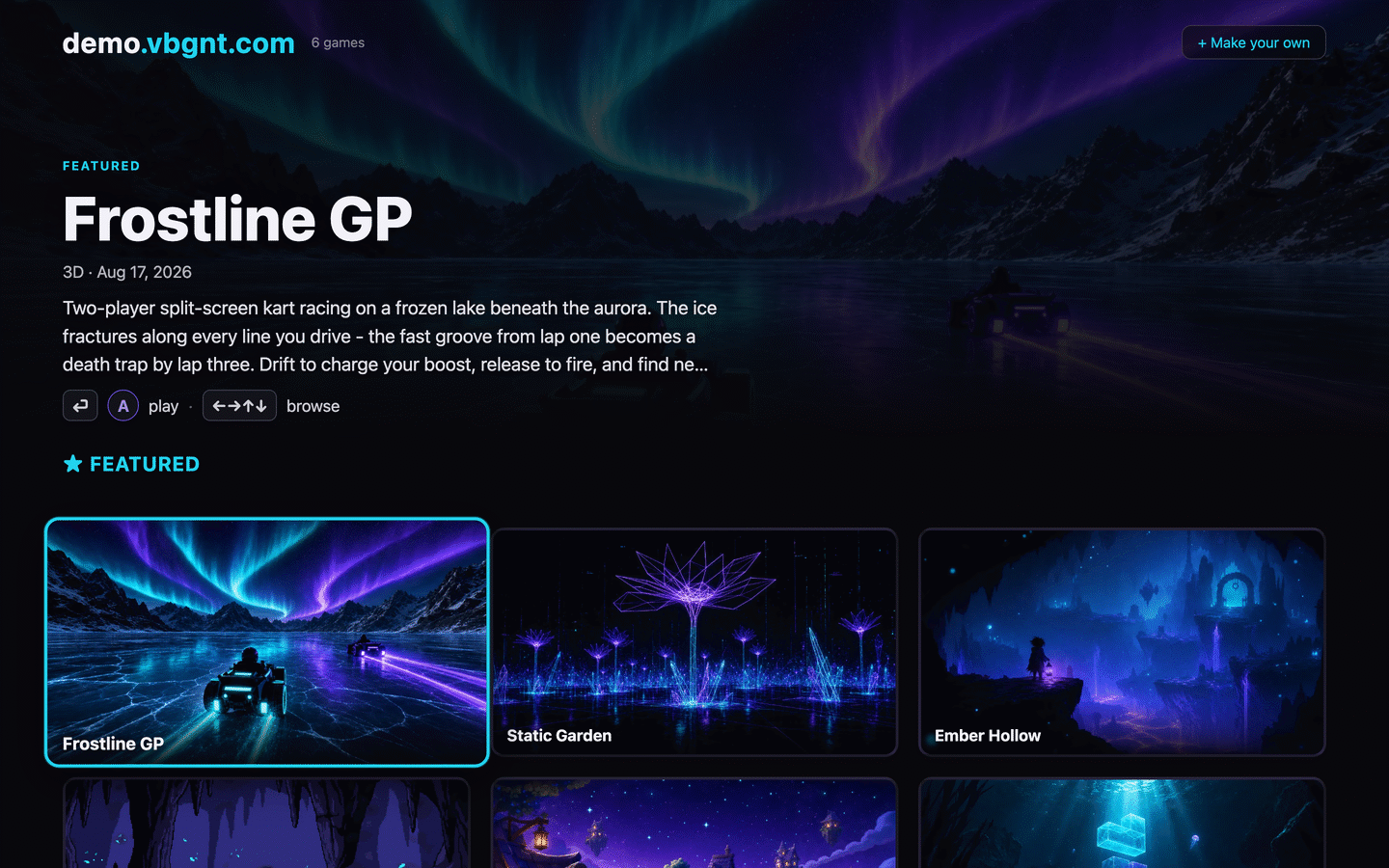

Back in July I wrote about building my own personal dream game console: think of a game, describe it, and have it playable on my phone, TV, and desktop about fifteen minutes later. I ended that post by saying it was strictly for personal use and not something I was going to commercialize.
I've changed my mind. It's a product now: vbgnt.com.
You can play the output right now
The fastest way to understand it is to go play something. Three games are up on the demo arcade at demo.vbgnt.com. No install, no account, they just open in your browser:
- Frostline GP, two-player split-screen kart racing on a frozen lake under the aurora. The ice fractures along every line you drive, so the fast groove from lap one is a death trap by lap three. Drift to charge boost, release to fire.
- Static Garden, a first-person walk through a garden made of light that only rewrites itself where you are not looking. No combat, no fail state; seven blooms to reach by deliberately turning away from them.
- Ember Hollow, a pixel-art puzzle-platformer about descending a cavern carrying the only light. You can hold the lamp or use your hands, never both. Set it down to climb, pull levers in the dark, then come back for the glow.
Each one started as a sentence.
What changed
The thing that kept the original build personal was the IP problem. My prompts were all "what if Mario Kart but with classic movie monsters," and the models were happy to oblige, somewhere between refusing outright and handing back a pixel-perfect recreation, with a detour through calling things "Wobbly Space Bears" to get around their own blocks. That's a fun toy and an unshippable product.
So the brief changed. You describe the game you want in your own words: a genre, a feel, an era, the one mechanic you actually care about. What comes back is an original game built to that description. A kart racer on a frozen lake. A one-button climber with a collapsing wall. A puzzle where stacking light is the mechanic. Turns out the interesting part was never the borrowed characters; it was the fifteen minutes.
What's underneath
Roughly the same machine as the personal version, hardened and pointed at other people:
- You describe it. One sentence is a complete brief. A paragraph and a pile of reference images works too.
- The agent builds it. A cloud microVM boots with the whole toolchain on it: Godot, the coding agent, generative 2D and 3D asset pipelines. It writes the code, generates the art and audio, and wires up touch, gamepad, and keyboard input. A real project, not a snippet.
- It plays its own game. Before you ever see the build, it gets loaded in a headless browser and driven: does it boot, does it hold framerate, does anything throw. Failures go back to the agent, not to you.
- It ships to your arcade. The web build publishes to
yourname.vbgnt.com. Send anyone the link and it opens on their phone, their laptop, or the browser on their TV.
Step 3 is the one that makes the rest work. The agent isn't emitting code and hoping. It opens the game, plays it, and reads its own console errors, so most of the failures never reach a human.
Invite-only for now
It's invite-only while I build it out. Request one and you'll get a single email when it's your turn. In the meantime, go crash a kart into some ice.